

From June 2026, games submitted for classification under the Pan-European Game Information (PEGI) system will be assessed against a significantly expanded set of criteria, with the inclusion of certain features, such as loot boxes, paid battle passes, and login-streak mechanics, directly impacting the age rating a game is given. Crucially, games containing loot boxes mechanics will automatically be rated PEGI 16, and games featuring countdown timers and other limited time offers will be automatically rated PEGI 12.
The changes represent the most substantive update to the PEGI classification system since the introduction of the "in-game purchases" content descriptor in 2019 and will have real consequences for how games are rated, and therefore how they are marketed and sold, across 38 countries.
Existing landscape
Loot boxes and other in-game monetisation mechanisms have been the subject of increasing regulatory scrutiny in both the UK and EU in recent years. See our article here on the BEUC’s call for stronger regulation of in-game monetisation, here for our article on the EU’s Consumer Protection Cooperation (CPC) Network’s key recommendations to protect users from harmful practices in video games, and here for our article on the intersection between in-game monetisation and consumer protection regulatory framework.
Under the existing PEGI system, age ratings of 3, 7, 12, 16, and 18 are used across 38 countries, to indicate a game's suitability for certain age groups. Prior to release, the games publisher is required to complete a detailed questionnaire covering the game's content across a range of categories, including violence, language, sexual content, drug use, and gambling. Based on the publisher's responses, PEGI's administrators assign the appropriate rating, which is then displayed on the game's packaging and digital storefronts. Alongside the age rating itself, PEGI uses a set of content descriptors to flag the presence of specific types of content or features, such as in-game purchases or paid random items.
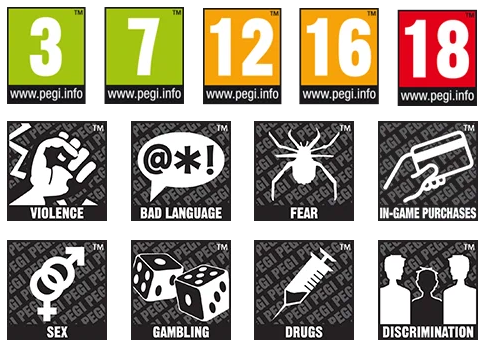
While PEGI already informs consumers about the presence of in-game purchases and paid random items through content descriptors, these indicators did not feed into the age rating itself, meaning a game could carry a PEGI 12 label and still contain a fully functioning loot box system. The incoming changes (outlined below) represent a fundamental shift in approach: for the first time, the presence of these mechanics will directly determine a game's age classification rather than simply appearing as an informational label alongside it.
As outlined in our latest Horizon Scan, the forthcoming Digital Fairness Act is expected to close perceived regulatory gaps left by existing legislation, particularly regarding B2C practices within digital services and games. PEGI's expansion of its classification criteria can be seen as a proactive step by the industry's self-regulatory body to get ahead of that legislative curve.
Incoming changes
On 12 March 2026, PEGI announced a new set of classification criteria taking effect from June 2026 for newly submitted games. The changes introduce four new categories of assessment:
- Purchases of in-game content. Games featuring time-limited or quantity-limited offers (such as paid battle passes with countdown timers) will be classified (at a minimum) PEGI 12. However, where a game includes in-game controls that disable spending by default, requiring a parent to actively enable purchases, that minimum rating can be reduced to PEGI 7. Games that incorporate NFTs or blockchain-related mechanisms that are required to play and can be traded in-game will be rated PEGI 18.
- Paid random items. Games containing paid random items, including loot boxes, card packs, gacha systems, and keys to unlock random rewards, will default to a minimum PEGI 16 rating. Social casino games may attract a PEGI 18 rating (as determined on a case-by-case basis).
- Play-by-appointment mechanics. Games that incentivise players to return, for example, through daily quests or login streaks, will receive a minimum PEGI 7 rating. Where those mechanics actively punish players for not returning (such as by causing loss of acquired content or reducing progress), the rating minimum rating rises to PEGI 12.
- Safe online gameplay. In cases where a game offers entirely unrestricted communication functionality, with no reporting or blocking mechanisms, it will be rated PEGI 18.
The changes were developed in close collaboration with Germany's age rating authority, USK, which introduced comparable reforms in 2023 following an update to the German Youth Protection Act. The German experience offers a useful indication of likely impact; according to USK's Managing Director Elisabeth Secker, “it has been a useful and successful change: at least one of the new USK criteria has been applied to approximately 30% of all games that were submitted since we updated our system. Around 1 in 3 of those games have been given a higher age rating as a result. The effect of the changes was visible and impactful”.
Publishers will be required to provide additional information upon submission where any of the features outlined above are present in a game, allowing PEGI administrators to assess the impact on classification. Games can be submitted in advance of their public announcement and release, and PEGI expects the first titles classified under the new framework to be announced in summer 2026.
Next steps for games developers
Naturally, a higher age rating can directly affect a game's commercial reach, with a jump from PEGI 12 to PEGI 16, or PEGI 16 to PEGI 18, restricting where and how a game is sold, how it is marketed, and whether it is accessible to a sizeable portion of its intended audience.
Where a developer implements meaningful structural protections, such as spending controls that are on by default, this can reduce the chances of being awarded a higher age rating. So, studios that build player protection into their games from the outset, rather than retrofitting it, will be better placed to manage their rating outcomes and consumer protection compliance.
As an immediate step, developers and publishers should review their pipeline titles against the new PEGI criteria, assess whether any mitigating design changes are viable and commercially appropriate, and factor the updated classification framework into their release and marketing strategies for titles launching in the summer.
This article is for general information purposes only and does not constitute legal advice. If you would like to discuss any of the issues raised, please contact our Games team.

/Passle/65c4b3ec7a33ecde2328516b/MediaLibrary/Images/2026-08-11-09-31-19-837-6a7aebe78407e466539a8085.jpg)
/Passle/65c4b3ec7a33ecde2328516b/MediaLibrary/Images/63d13afbf636e918380ad1f9/2024-03-25-21-44-03-456-6601f023f932d38f3d6707bd.jpg)
/Passle/65c4b3ec7a33ecde2328516b/MediaLibrary/Images/2026-01-26-16-43-57-994-697799cd812a5c2d344bbc44.jpg)
/Passle/65c4b3ec7a33ecde2328516b/MediaLibrary/Images/2026-07-28-09-34-11-096-6a6877932f7f4abc6243eb3d.jpg)